
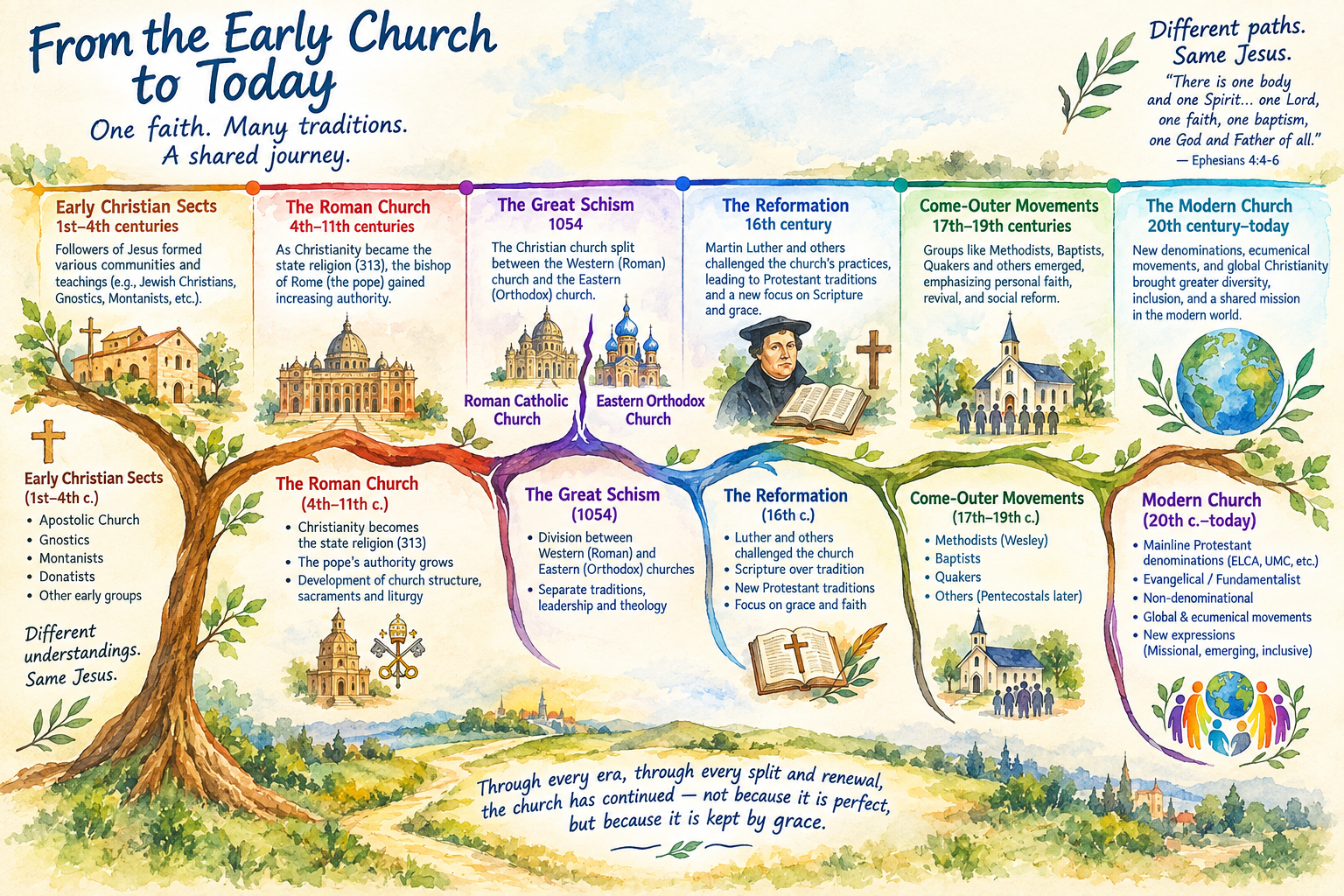
Christian History: One Faith, Many Traditions
Christianity has a long, rich history. Today, Christians worship in many different traditions, from Roman Catholic and Eastern Orthodox churches to Lutheran, Methodist, Baptist, Presbyterian, Pentecostal, and non-denominational congregations.
Why are there so many kinds of churches? What do they have in common? And how do you find a church that fits your beliefs and values?
Understanding Christian denominations begins with a simple idea: Christians share a faith in Jesus Christ, but they sometimes differ in how they understand Scripture, worship, church leadership, and what it means to live out their faith.
The Early Church: The First Centuries
Christianity began with Jesus and his followers in the first century. The earliest Christian communities spread throughout the Roman Empire and beyond, developing congregations in places such as Jerusalem, Antioch, Alexandria, and Rome.
These communities shared faith in Jesus but did not always agree about his identity, Christian teaching, worship, and church authority. Over time, church leaders developed statements of faith, including the Nicene Creed, to express foundational Christian beliefs.
Some early movements eventually separated from the churches that came to define mainstream Christianity. Others developed into distinct Christian traditions that continue today.
The Ancient Church: Different Christian Traditions Emerge
As Christianity spread, regional churches developed their own languages, customs, and leadership structures. Major councils in the fourth and fifth centuries addressed disagreements about Christian teaching.
Some churches separated over theological disputes, including disagreements associated with the Council of Chalcedon in 451. These communities helped shape what are now known as the Oriental Orthodox Churches, including the Coptic, Armenian, and Syriac traditions.
The Church of the East also developed a distinct history, especially across the Persian Empire and farther east.
These traditions are ancient Christian communities, not modern offshoots of Roman Catholicism or Protestantism.
1054 and the East–West Schism
For centuries, Christianity's eastern and western churches grew apart. Differences involving theology, language, culture, church authority, and political relationships contributed to the division commonly associated with 1054.
The Roman Catholic Church developed in communion with the bishop of Rome, the pope. The Eastern Orthodox Churches continued through a communion of self-governing churches led by bishops and patriarchs.
The separation was a long process rather than a single event, and Catholic and Orthodox Christians continue to share many historic Christian beliefs, sacraments, and liturgical practices.
The Protestant Reformation: The 1500s
In the sixteenth century, reformers challenged aspects of Western church teaching and practice. Martin Luther's reform movement began in 1517. Other reform movements developed in Switzerland, across Europe, and in England.
These movements led to several major Protestant traditions:
Lutheran: Emphasizes God's grace, forgiveness through Jesus Christ, and the central role of Scripture. Lutheran worship often retains historic liturgy and sacraments.
Reformed and Presbyterian: Emphasizes God's sovereignty, covenant, Scripture, and, in many traditions, a representative system of church governance.
Anglican and Episcopal: Combines elements of historic Catholic worship and structure with Protestant reform traditions.
Anabaptist: Emphasizes believers' baptism, discipleship, community, and, in many communities, nonviolence.
Other Protestant traditions: Additional churches developed through different reform movements, theological convictions, and local histories.
The Reformation did not create one unified Protestant church. It began a family of traditions that continued to develop over the following centuries.
Revival, Renewal, and New Church Movements
From the seventeenth through the nineteenth centuries, new movements emphasized personal faith, spiritual renewal, evangelism, and reform.
Baptists emphasize baptism of professing believers and the importance of local congregations.
Quakers emphasize direct spiritual experience, community discernment, and, in many communities, peace and equality.
Methodists grew from the eighteenth-century revival associated with John and Charles Wesley, emphasizing grace, spiritual growth, and practical service.
Restorationist movements sought to recover patterns of Christian faith and church life found in the New Testament.
Holiness movements emphasized sanctification and growth in holy living.
Adventist movements developed distinctive teachings concerning Christ's return and, in some traditions, Sabbath observance.
In the twentieth century, Pentecostal and charismatic movements brought renewed attention to the work of the Holy Spirit, spiritual gifts, and expressive worship. Independent and non-denominational churches also became more widespread.
Today, Christianity is a global faith with many traditions, languages, worship styles, and approaches to Christian life.
Learn more about…
From the Early Church to Today