
Which Lutheran Tradition Is Right for You?
One Lutheran heritage. Different ways of living out our faith.
If you’ve ever wondered why there are so many different kinds of Lutheran churches, you’re not alone!
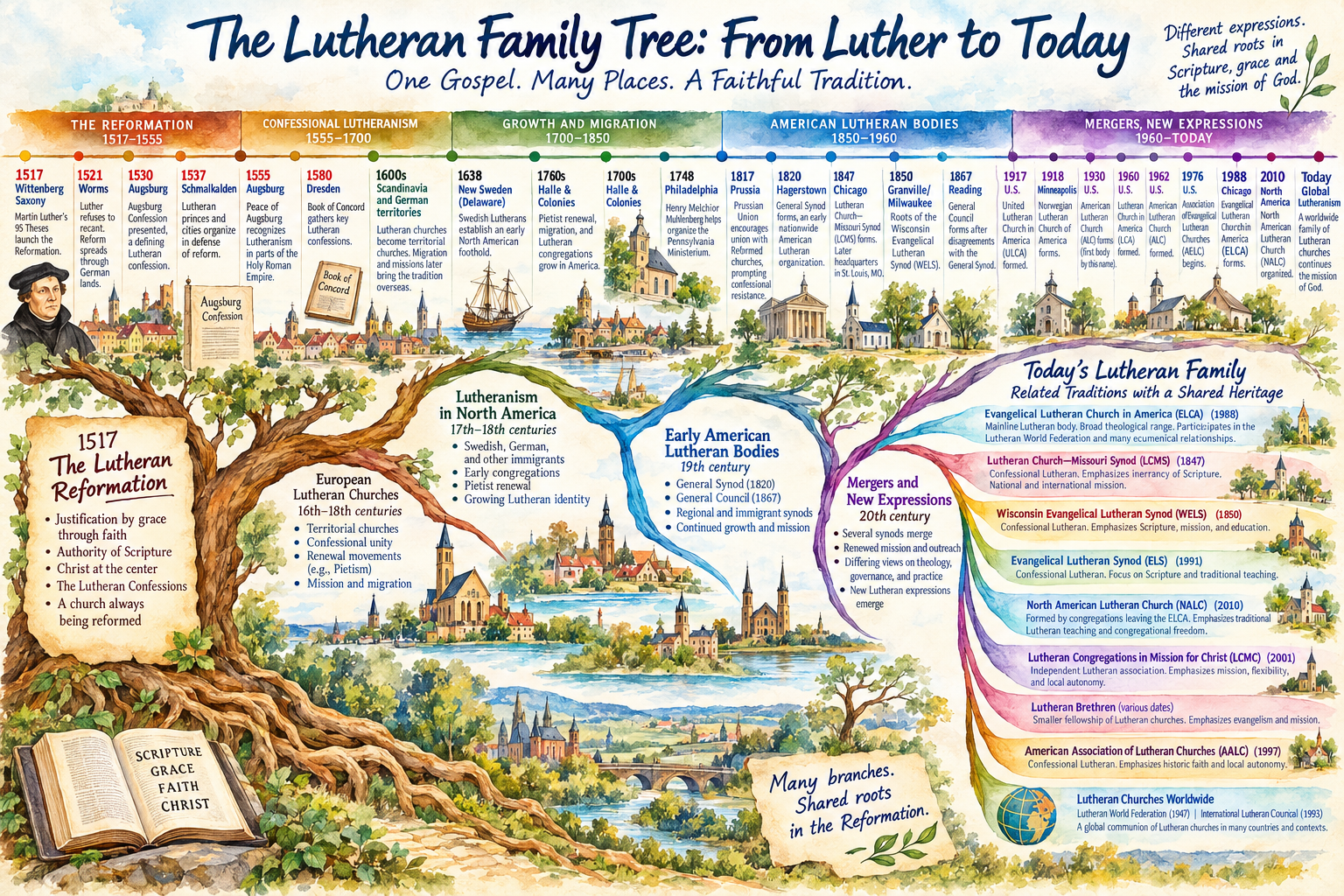
All Lutheran churches trace their roots to the 16th-century Reformation led by Martin Luther. We share a rich theological heritage centered on Jesus Christ, God's grace, faith, Scripture, and the promise of forgiveness. Over the centuries, disagreements about biblical interpretation, worship, church authority, and social questions have led to different Lutheran denominations.
Today, Lutheran congregations can look and feel quite different from one another. Some emphasize traditional doctrine and worship. Others place a strong emphasis on ecumenical relationships, social engagement, and inclusion. Many combine several of these commitments.
The important question isn't simply which Lutheran church is right. It's where you'll find a Christian community in which you can grow in faith, ask honest questions, serve your neighbors, and belong.
A Brief History of Lutheran Traditions
1517 — The Lutheran Reformation begins
Martin Luther, a professor and priest in Wittenberg, Germany, challenges church practices and calls for reform. His teaching emphasizes salvation by God's grace through faith in Jesus Christ.
1530 — The Augsburg Confession
Lutheran leaders present a statement of faith that becomes a foundational document of Lutheran theology.
1847 — The Lutheran Church—Missouri Synod (LCMS)
German Lutheran immigrants and pastors organize a synod in the United States, emphasizing confessional Lutheran teaching and a strong commitment to their understanding of biblical authority.
1850 — The Wisconsin Evangelical Lutheran Synod (WELS)
Lutheran congregations organize a synod that develops a distinct confessional identity, emphasizing Scripture, Lutheran doctrine, Christian education, and mission.
1917 — The United Lutheran Church in America (ULCA)
Several Lutheran bodies unite, contributing to the stream of American Lutheranism that will eventually become part of the ELCA.
1988 — The Evangelical Lutheran Church in America (ELCA)
Three major Lutheran church bodies—the Lutheran Church in America (LCA), the American Lutheran Church (ALC), and the Association of Evangelical Lutheran Churches (AELC)—merge to form the ELCA. The new church continues a tradition of theological scholarship, ecumenical cooperation, and engagement with contemporary social questions.
1991 — The Evangelical Lutheran Synod (ELS)
The ELS, organized in its modern form in 1918, continues a confessional Lutheran tradition closely related to the Wisconsin Synod.
2001 — Lutheran Congregations in Mission for Christ (LCMC)
LCMC forms as an association of Lutheran congregations emphasizing congregational autonomy, mission, and flexibility in church governance.
2010 — The North American Lutheran Church (NALC)
The NALC forms following disagreements within North American Lutheranism, including debates about biblical interpretation, human sexuality, and church teaching.
These dates describe important organizational milestones, not the beginning of Lutheran faith itself. Each denomination has its own history, and Lutheranism has also developed into a worldwide family of churches.

Meet Some of Today's Lutheran Traditions
Evangelical Lutheran Church in America (ELCA)
Formed: 1988
Theological character: Broad, historically grounded, and engaged with the contemporary world.
The ELCA emphasizes God's grace in Jesus Christ, Scripture, the Lutheran Confessions, thoughtful theological interpretation, and service to neighbors. It participates in ecumenical partnerships and encourages conversation about difficult questions of faith and public life.
Women in ministry: The ELCA ordains women as pastors and welcomes women into leadership throughout the church, including synodical and churchwide leadership.
LGBTQ+ inclusion: The ELCA supports LGBTQIA+ people's dignity and participation in the life of the church. Its policies allow congregations to call LGBTQ+ pastors in publicly accountable, lifelong, monogamous same-gender relationships. Congregations differ in their practices concerning same-gender marriage, so visitors may wish to ask about a particular congregation.
Social engagement: ELCA congregations often participate in hunger relief, community service, creation care, racial justice, refugee support, and other ministries. Congregations vary in their priorities and political perspectives.
You may appreciate an ELCA congregation if you value: Lutheran theology, women pastors, LGBTQ+ affirmation, open theological discussion, community service, and engagement with the wider world.
Lutheran Church—Missouri Synod (LCMS)
Formed: 1847
Theological character: Confessional and doctrinally conservative.
The LCMS places strong emphasis on the authority of Scripture, the Lutheran Confessions, historic Christian teaching, and traditional Lutheran worship. It maintains a clear distinction between the church's teaching and changing cultural attitudes.
Women in ministry: Women are not ordained as pastors. Women do serve in many other important ministry and leadership roles.
LGBTQ+ teaching: The LCMS teaches that sexual relationships belong within marriage between a man and a woman. Its official teaching does not affirm same-sex sexual relationships.
Social engagement: LCMS congregations participate in evangelism, Christian education, humanitarian service, and local outreach, generally within a conservative theological framework.
You may appreciate an LCMS congregation if you value: Confessional precision, traditional doctrine, historic Lutheran worship, and a conservative interpretation of Scripture.
Wisconsin Evangelical Lutheran Synod (WELS)
Organized: 1850
Theological character: Confessional and conservative, with a strong emphasis on biblical authority.
WELS emphasizes salvation by grace through faith, the authority of Scripture, Lutheran doctrine, Christian education, and evangelism.
Women in ministry: Women are not ordained as pastors. WELS teaches distinct roles for men and women in the church, while recognizing many forms of women's service.
LGBTQ+ teaching: WELS maintains traditional teaching concerning marriage and sexual relationships.
Social engagement: Congregations often emphasize evangelism, schools, youth ministry, mission work, and local service.
You may appreciate a WELS congregation if you value: Strong doctrinal continuity, Lutheran schools and education, traditional teaching, and a close-knit congregational life.
North American Lutheran Church (NALC)
Formed: 2010
Theological character: Traditional, Christ-centered, and mission-oriented.
The NALC emphasizes Scripture, the Lutheran Confessions, congregational life, evangelism, and mission. It emerged amid disagreements over theology and human sexuality in North American Lutheranism.
Women in ministry: The NALC permits the ordination of women, although congregations and leaders may hold different views about women's ordination.
LGBTQ+ teaching: The NALC maintains traditional teaching on marriage and sexuality and does not share the ELCA's approach to affirming same-gender relationships for ordained ministry.
You may appreciate an NALC congregation if you value: Traditional Christian teaching, mission, a strong Lutheran identity, and a church body seeking a distinct alternative to the ELCA.
Lutheran Congregations in Mission for Christ (LCMC)
Formed: 2001
Theological character: Generally more conservative than the ELCA, emphasizing biblical authority and congregational independence.
LCMC formed in 2001 amid disagreements within the ELCA over church authority, Lutheran identity, and theological direction. Debates about human sexuality became a major point of division, particularly after the ELCA adopted its 2009 social statement on sexuality and allowed congregations to call pastors in same-gender relationships.
Key differences from the ELCA:
Theology: LCMC congregations generally take a more conservative approach to biblical interpretation and traditional Christian teaching.
LGBTQ+ inclusion: Many LCMC congregations maintain traditional teachings on marriage and sexuality, while the ELCA permits LGBTQ+ pastors in qualifying same-gender relationships and supports LGBTQ+ inclusion.
Women pastors: LCMC permits women pastors, although individual congregations differ in their practice. The ELCA ordains women and supports their leadership throughout the church.
Governance: LCMC gives local congregations substantial independence in setting their direction and practices.
You may appreciate an LCMC congregation if you value: traditional Christian teaching, local church autonomy, and a strong emphasis on mission and evangelism.
Both LCMC and the ELCA share Lutheran roots, but differ in their theological approaches, governance, and practices concerning human sexuality.
Evangelical Lutheran Synod (ELS)
Organized: 1918
Theological character: Confessional Lutheran and doctrinally conservative.
The ELS maintains a close historical and theological relationship with WELS. It emphasizes Scripture, the Lutheran Confessions, traditional Christian teaching, and mission.
Women in ministry: Women are not ordained as pastors.
LGBTQ+ teaching: The ELS maintains traditional teaching on marriage and sexual relationships.
You may appreciate an ELS congregation if you value: A smaller confessional Lutheran church body, traditional doctrine, and continuity with historic Lutheran teaching.
What Do These Differences Mean for You?
When visiting a Lutheran congregation, consider asking:
What will worship be like? Do you prefer a traditional liturgy, contemporary music, or a mixture?
How does the congregation understand the Bible? Is there room for historical study, theological questions, and differing interpretations?
Who can serve as a pastor? Does the congregation ordain women, and what leadership roles are available to them?
Are LGBTQ+ people fully included? Can LGBTQ+ people serve openly in leadership? Does the congregation celebrate same-gender marriages?
How does the church serve its neighbors? Does it participate in hunger relief, social ministry, education, advocacy, or other community programs?
What does belonging look like? Will you find opportunities to build relationships, ask questions, volunteer, and grow in faith?
A denominational label can tell you a great deal, but it cannot tell you everything about a particular congregation. Local practices, leadership, worship, and community life matter, too.
Where Does Faith Lutheran Fit?
Faith Lutheran Church is part of the Evangelical Lutheran Church in America (ELCA).
We believe God's grace is a gift—not something we earn by believing perfectly, living perfectly, or having every question answered.
We welcome women and men into pastoral ministry and leadership. We affirm LGBTQ+ people and seek to make our congregation a place where people of every sexual orientation and gender identity can participate fully in the life of the church.
We value thoughtful faith, meaningful worship, personal relationships, and serving our neighbors. We believe questions are part of a living faith, and you don't need to have everything figured out before you walk through our doors.
You don't have to be Lutheran to visit Faith. You don't have to know the liturgy. You don't have to pretend to have all the answers.
Come as you are. Worship with us. Get to know us. Ask your questions. Discover what God's grace might mean for your life.
Faith Lutheran Church
155 Boyson Road, Marion, Iowa
Sunday worship at 9:00 AM
www.FaithLutheran.org
319.377.9700
There's a place for you here.
Learn more about…
From the Early Church to Today