
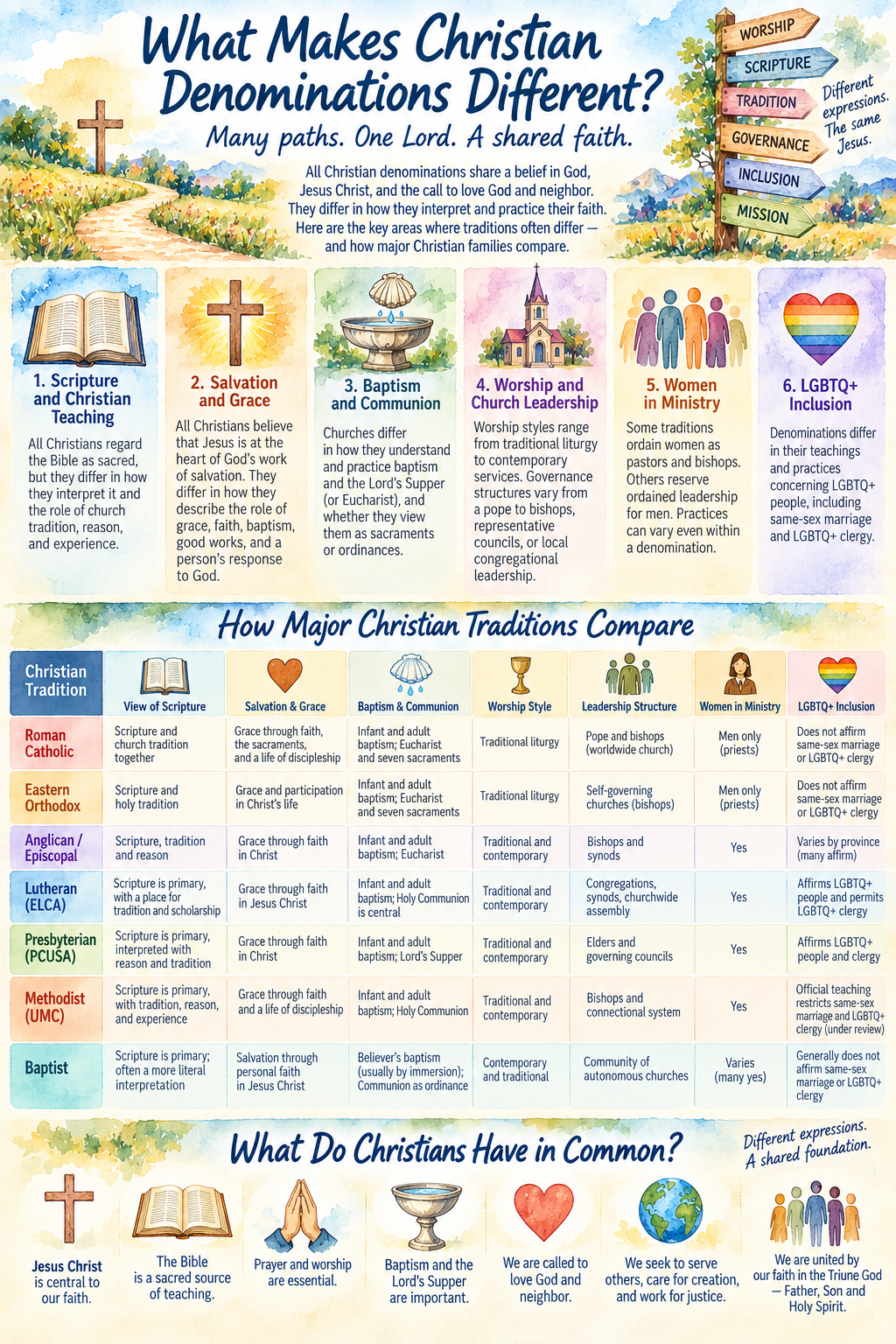
What Makes Christian Denominations Different?
Although Christian denominations share many beliefs, they differ in how they interpret and practice their faith. These differences often fall into a few key areas.
1. Scripture and Christian Teaching
Most Christian traditions regard the Bible as sacred Scripture, but they differ in how they interpret it and how they understand its relationship to church tradition, reason, and experience.
Catholic and Orthodox churches give significant weight to Scripture as understood within the historic teaching, worship, and tradition of the church.
Protestant churches generally emphasize the authority of Scripture, although they differ in interpretation and in the role given to tradition and reason.
Some evangelical and conservative traditions emphasize a more literal reading of particular biblical passages.
Many mainline Protestant traditions use historical and literary scholarship alongside faith, prayer, and theological reflection.
Christians within the same denomination may also disagree about particular biblical passages and their application today.
2. Salvation and Grace
Christians share the central belief that Jesus Christ is at the heart of God's work of salvation. They differ in how they explain the relationship between God's grace, faith, baptism, good works, and a person's response to God.
Lutherans emphasize that salvation is a gift of God's grace, received through faith rather than earned by human effort. Catholic, Orthodox, and other Protestant traditions have their own theological ways of describing grace, faith, transformation, and the Christian life.
Across these traditions, Christian discipleship is commonly understood as a response to God's love, expressed through worship, service, and care for others.
3. Baptism and Communion
Christian churches differ in how they understand and practice the sacraments or ordinances.
Roman Catholic and Eastern Orthodox: Baptism and the Eucharist are central to sacramental life, alongside other recognized sacraments.
Lutheran: Baptism and Holy Communion are central means through which God offers grace. Lutherans baptize infants and children as well as adults.
Reformed and Presbyterian: Baptism and the Lord's Supper are central practices, understood through their particular theological traditions.
Baptist and many evangelical churches: Baptism is generally reserved for those who personally profess faith, and communion is commonly understood as an ordinance of remembrance and proclamation, though views vary.
These differences can shape worship, membership, and family decisions about baptism and communion.
4. Worship and Church Leadership
A Sunday service can look very different from one Christian tradition to another.
Some churches use historic liturgies, written prayers, creeds, traditional hymns, and a church calendar. Others emphasize contemporary music, informal preaching, spontaneous prayer, or extended opportunities for personal testimony. Many combine traditional and contemporary elements.
Church governance also varies. Catholicism has a worldwide structure centered on the pope. Orthodox churches are organized through self-governing churches led by bishops. Episcopal and Anglican churches have bishops, while Presbyterian churches use representative assemblies. Many Baptist and independent churches place substantial authority in local congregations.
Different forms of worship and leadership reflect different understandings of how the church should gather, teach, and serve.
5. Women in Ministry
Christian denominations also differ in who may serve as pastors, priests, bishops, and other ordained leaders.
Some traditions reserve particular ordained offices for men. Others ordain women to pastoral and episcopal leadership. Policies and practices can vary even among congregations within a broader Christian tradition.
The Evangelical Lutheran Church in America (ELCA) ordains women and welcomes them into pastoral and other leadership roles.
6. LGBTQ+ Inclusion
Christian traditions and congregations differ in their teachings and practices concerning LGBTQ+ people, including same-sex marriage and LGBTQ+ clergy.
Some denominations maintain that marriage is between a man and a woman and restrict ordination to people who meet their traditional sexual ethics requirements. Other denominations affirm same-sex relationships and welcome LGBTQ+ people into ordained leadership and marriage. Within some denominations, congregations and individual members hold differing views.
The ELCA has an LGBTQ+-affirming path for ministry and marriage. It permits congregations to choose whether to conduct or recognize same-sex marriages, and it provides for LGBTQ+ people to serve as rostered ministers under its policies. Individual congregations may differ in how they practice welcome and inclusion.
At Faith Lutheran Church in Marion, Iowa, we seek to welcome people of all sexual orientations and gender identities into the life and community of the church.
Where Does the ELCA Fit?
The Evangelical Lutheran Church in America is one of several Lutheran church bodies. Lutheranism began during the Protestant Reformation in the sixteenth century, drawing on the teachings of Martin Luther and other reformers.
The ELCA was formed in 1988 through the merger of three Lutheran church bodies in the United States. It belongs to the broader Lutheran tradition while participating in ecumenical relationships with Christians from other denominations.
ELCA congregations commonly emphasize:
Grace: God's love is a gift, not something we earn.
Faith in Jesus Christ: Jesus stands at the center of Christian life and hope.
Scripture and learning: The Bible is studied with attention to its historical context, literary forms, and meaning for life today.
Baptism and Holy Communion: These are central practices through which God's promises are proclaimed and received.
Women in leadership: Women may serve as pastors and bishops.
LGBTQ+ affirmation: The church provides pathways for LGBTQ+ people to serve in ordained ministry and supports congregational choices concerning same-sex marriage.
Service to neighbors: Faith is lived out through compassion, justice, generosity, and care for the world.
The ELCA is part of the mainline Protestant tradition. It includes a range of theological perspectives, and members do not necessarily agree on every issue.
What Do Christians Have in Common?
Despite their differences, many Christian traditions share foundational beliefs and practices:
Jesus Christ is central to Christian faith.
The Bible is a sacred source of Christian teaching.
Prayer and worship are important expressions of faith.
Baptism and the Lord's Supper or Eucharist are significant Christian practices, though their meanings and administration differ.
Love of God and neighbor is central to Christian discipleship.
Christians are called to serve others, care for those in need, and work toward peace and reconciliation.
The historic Christian creeds express shared beliefs in the Trinity, Jesus Christ, and the resurrection, though not every Christian-origin movement accepts them.
Christian unity does not mean that every church teaches the same things. It means that Christians continue to seek faithfulness to Christ while navigating differences in belief, history, and practice.
Learn more about…
From the Early Church to Today